Evaluating Chewy Geewy: A Practical Look at This Groovy Bubbly Typeface
In the crowded landscape of display typography, finding a font that balances distinct personality with genuine legibility can be a challenge for designers and brand builders. Chewy Geewy emerges as a notable contender in this space, offering a specific aesthetic that leans heavily into retro-inspired, bubbly forms. For professionals ranging from freelance graphic designers to small business owners looking to refresh their visual identity, understanding the practical applications and technical capabilities of a typeface is essential before integrating it into a workflow. This analysis breaks down what Chewy Geewy offers, how it performs in real-world scenarios, and who stands to benefit most from its unique characteristics.
Defining the Aesthetic and Core Characteristics
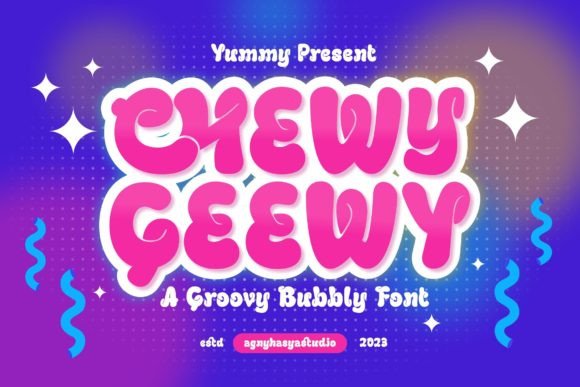
At its core, Chewy Geewy is defined by its playful, groovy, and bubbly nature. It does not attempt to be a neutral sans-serif or a traditional serif; instead, it commits fully to a stylized look that evokes a sense of fun and nostalgia. The letterforms are rounded and inflated, creating a soft, approachable feel that immediately lowers the visual barrier between the content and the viewer. This makes it particularly effective for projects where the goal is to appear friendly, accessible, and energetic rather than corporate or severe.
The typeface is available in two primary styles: Regular and Slant. This duality provides a basic but useful level of flexibility. The Regular style offers a stable, upright presence suitable for headlines that need to sit firmly on a baseline, while the Slant variant introduces a sense of motion and dynamism. This slanted version can be particularly effective in advertising contexts where implying speed, excitement, or forward momentum is beneficial. Having both options within the same family ensures consistency across different design elements without needing to mix disparate fonts.
Technical Functionality and Glyph Access
Beyond the visual style, the technical construction of a font dictates its usability in professional software. Chewy Geewy is PUA encoded (Private Use Area). For those unfamiliar with this term, it is a crucial feature that significantly enhances the font's versatility. PUA encoding allows users to access special glyphs, alternate characters, and ligatures directly through standard character maps or OpenType panels in design software like Adobe Illustrator, Photoshop, or InDesign.
This technical specification means that the "amazing glyphs and ligatures" mentioned in the font's documentation are not hidden or difficult to reach. Designers can easily swap out standard letters for more decorative alternates to break up repetitive patterns in a wordmark or create unique typographic locks. For example, if a logo feels too uniform, a user can quickly substitute a standard 'e' or 'o' with a stylistic alternate to add a custom touch. This level of control is vital for branding projects where uniqueness is a key requirement. It transforms the font from a static set of letters into a flexible toolkit for creation.
Practical Applications in Branding and Marketing
When evaluating where Chewy Geewy fits best, one must consider the psychological impact of its shape language. The bubbly, rounded forms suggest creativity, youthfulness, and informality. Consequently, this typeface shines in specific sectors:
- Product Packaging: For consumables like candies, snacks, beverages, or children's products, the font's soft edges mimic organic shapes and suggest sweetness or fun. It works well on labels where shelf appeal relies on catching the eye quickly.
- Event Branding: Special events, festivals, and parties often require typography that feels celebratory. Chewy Geewy's groovy vibe aligns well with themes ranging from 70s retrospectives to modern pop-up markets.
- Social Media and Advertising: In digital ads where attention spans are short, a distinctive display font can stop the scroll. The high contrast between the thick strokes and the white space within the bubbles makes it readable even at smaller sizes, provided the line length is kept short.
- Book Covers and Magazine Titles: For genres such as humor, lifestyle, cooking, or young adult fiction, this typeface can serve as a strong title element that sets the tone before the reader even opens the book.
However, it is important to maintain objectivity regarding its limitations. While excellent for headlines and logos, Chewy Geewy is not designed for body copy. The exaggerated proportions and decorative nature of the letters would cause eye fatigue if used for paragraphs of text. Its value lies in its ability to act as an accent—a powerful visual hook rather than a workhorse for long-form reading.
Workflow Integration and Long-Term Value
For entrepreneurs and marketers managing their own design needs, the ease of use is a significant factor. The inclusion of ligatures and alternates via PUA encoding streamlines the customization process. Instead of needing advanced vector editing skills to modify individual letters in Illustrator, a user can often achieve a custom look simply by typing specific character codes or selecting glyphs from a panel. This efficiency saves time during the iterative design phase, allowing for rapid prototyping of logo concepts or ad variations.
Furthermore, the consistency between the Regular and Slant styles ensures that a brand can maintain a cohesive identity across different media. A business might use the Regular style for their primary logo and the Slant style for promotional banners or sale tags, creating a unified yet dynamic visual system. This kind of internal consistency builds brand recognition over time, which is a critical component of long-term marketing success.
Who Should Consider This Typeface?
Chewy Geewy is not a one-size-fits-all solution, and recognizing its ideal audience is part of making a smart design investment. It is best suited for:
- Creative Agencies and Freelancers: Professionals who need a reliable, fun display font for client projects in the food, entertainment, or education sectors will find it a valuable addition to their library.
- Small Business Owners: Entrepreneurs launching products that rely on a friendly, approachable image can use this font to differentiate themselves from competitors using generic, sterile typography.
- Educators and Content Creators: Teachers creating engaging classroom materials or YouTubers designing thumbnails for family-friendly content can leverage the font's clarity and charm to connect with their audience.
- Publishers: Those working on titles that require a strong, character-driven voice will appreciate the personality inherent in the letterforms.
Conversely, industries requiring a tone of seriousness, authority, or minimalism—such as law, finance, or high-end luxury tech—would likely find this typeface mismatched with their brand values. The "groovy" descriptor is accurate; it carries a specific cultural weight that may clash with corporate conservatism.
Final Assessment on Usability and Effectiveness
In terms of overall quality and presentation, Chewy Geewy delivers on its promise of being a playful and functional asset. The decision to include two styles and robust PUA support demonstrates a thoughtful approach to font development, prioritizing user flexibility. The letterforms are well-constructed, maintaining legibility despite their decorative nature. The spacing appears balanced, reducing the need for excessive manual kerning in most headline applications, though professional designers should always review tracking on a case-by-case basis.
Ultimately, the value of Chewy Geewy lies in its ability to inject immediate personality into a project. It solves the common problem of "bland typography" for specific niches without sacrificing readability. For the right project, it acts as more than just a set of characters; it becomes a central element of the visual strategy. When chosen with an understanding of its strengths and appropriate context, it serves as a reliable tool for creating memorable, engaging, and effective designs.